Early access · Private preview
Cookbook
Invoice reconciliation
Match a new invoice to its purchase order and get back a decision your finance team can act on.
A finance agent checks each invoice against its purchase order: vendor, line items, quantities, prices, and totals. Vendors and amounts change on every run, but the matching rules don't. This is the job behind the measured run in the repeat-cost essay: about 450x cheaper and 16x faster than Opus 5.5 on one run of each.
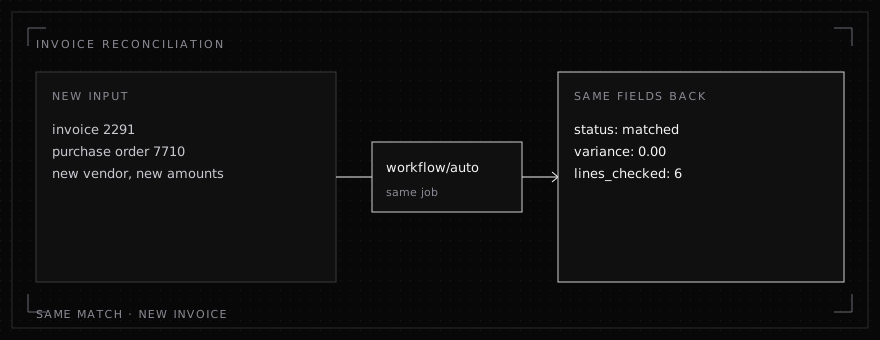
The job
- New each run: the vendor, the invoice and purchase order numbers, the line items, and the amounts.
- Same each run: your tolerance, your match rules, and the decision fields your system records.
The call
python
import json
from openai import OpenAI

client = OpenAI(api_key="YOUR_KEY", base_url="https://api.inferenceindex.com/v1")

RULES = """Match the invoice to the purchase order line by line.
Tolerance: 1% per line. Return JSON with keys:
status (matched|variance|mismatch), variance (number), lines_checked (integer),
issues (list of strings)."""

def reconcile(invoice: str, purchase_order: str) -> dict:
    response = client.chat.completions.create(
        model="workflow/auto",
        messages=[
            {"role": "system", "content": "You reconcile invoices for accounts payable. " + RULES},
            {"role": "user", "content": f"Invoice:\n{invoice}\n\nPurchase order:\n{purchase_order}"},
        ],
    )
    return json.loads(response.choices[0].message.content)
What comes back
An example reply when every line matches:
json
{
  "status": "matched",
  "variance": 0.0,
  "lines_checked": 6,
  "issues": []
}
In production
- Approve
matchedautomatically, and sendvarianceandmismatchto a person, as your process does today. - The invoice values are new on every run. This is the case a response cache gets wrong, because it returns yesterday's total. See how it works.
- An invoice format your agent has never handled goes to your fallback model.