Early access · Private preview
Start here
How it works
Workflow Compilation turns a workflow your agent already runs into a Compiled Agent Model, with your current model as the fallback.
A Compiled Agent Model comes from Workflow Compilation. Your agent runs a workflow today on a frontier model. Workflow Compilation builds a model for that one workflow, so the next run of the same job, with new values, doesn't need to go back through a frontier model.
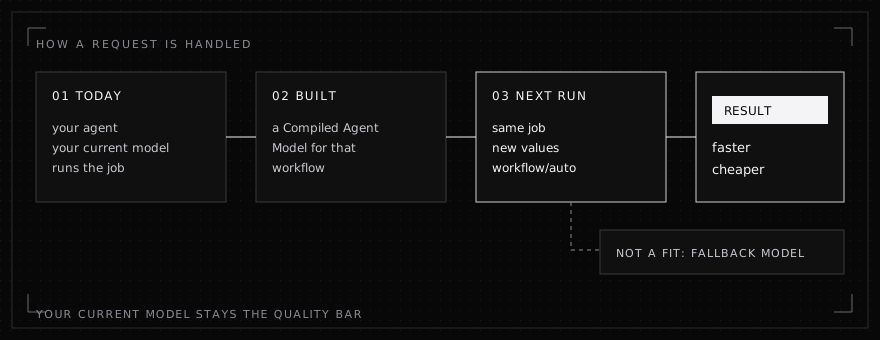
The lifecycle of a request
- Today. Your agent runs the job on the model you use now, with your prompts, tools, and checks.
- Built. Workflow Compilation produces a Compiled Agent Model for that workflow from your agent's completed runs. It is specific to your job. It is not a general-purpose model.
- Next run. You send the next request to
workflow/auto. When it's the same job with new values, the Compiled Agent Model handles it, faster and for a fraction of the cost. - Not a fit. When a request isn't the job it knows, it goes to your fallback model, the frontier model you already use. You get the result you would have gotten today.
Your client doesn't change between steps 3 and 4. Both use the same endpoint, model name, and response format.
Same job, new values
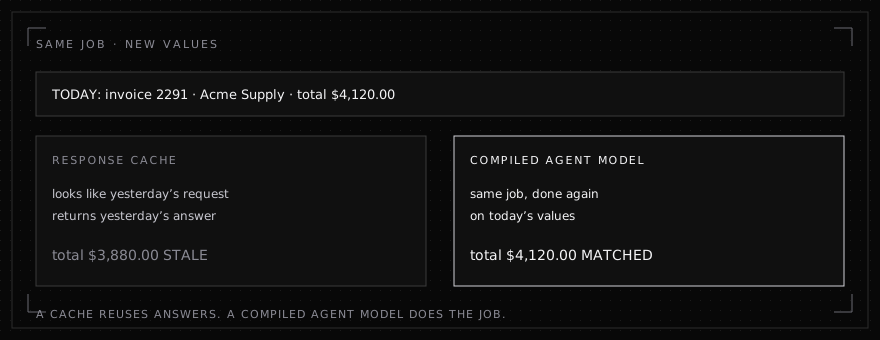
This is where it differs from a cache. Tomorrow's invoice has a different vendor, different amounts, and a different date. A response cache either misses, or it sees a request that looks familiar and returns yesterday's total. A Compiled Agent Model does the job again on today's values.
What it is not
People usually compare it to one of these. Here is how each one differs.
| Approach | What you get | Where it stops |
|---|---|---|
| Prompt caching | Cheaper cached input and a faster first token | Output, reasoning, and a frontier call on every step are still paid |
| Response or semantic cache | An instant stored answer | Misses, or returns the old answer, when the values change |
| A cheaper open-weight model | A lower price per token on a general model | It's a general model, so quality on your workflow is whatever you get, and you have to evaluate and maintain it yourself |
| Fine-tuning your own model | A model shaped to your data | You collect the data, train, evaluate, host, and keep it current, and there is no fallback unless you build one |
| Compiled Agent Model | A faster, cheaper run of a job your agent already does | Anything new goes to your current model |
The comparison with caching is covered in more depth in what caching saves for AI agents.
What stays yours
- Your quality bar. Your current model is the fallback, so a request the Compiled Agent Model doesn't fit gets the answer you get today.
- Your workflow. Your prompts, tools, and checks still define the job. A Compiled Agent Model runs that job. It doesn't replace your product logic.
- Your client code. It's the OpenAI-compatible chat completions request you already send, with a different base URL and model name.
What the numbers look like
Repeat runs are often 10-100x cheaper on our tests. On one measured invoice reconciliation run, a Compiled Agent Model was about 450x cheaper and 16x faster than Opus 5.5. That is one run of one task per model, not a claim about every workflow. See the repeat-cost essay.