Private beta · Early access
Platform
Skills
Save a job once as a skill, including a standard SKILL.md, then call it by its model name.
Private beta. InferenceIndex is changing fast. Models, endpoints, pricing and these docs may change without notice, so check back before you build on a detail.
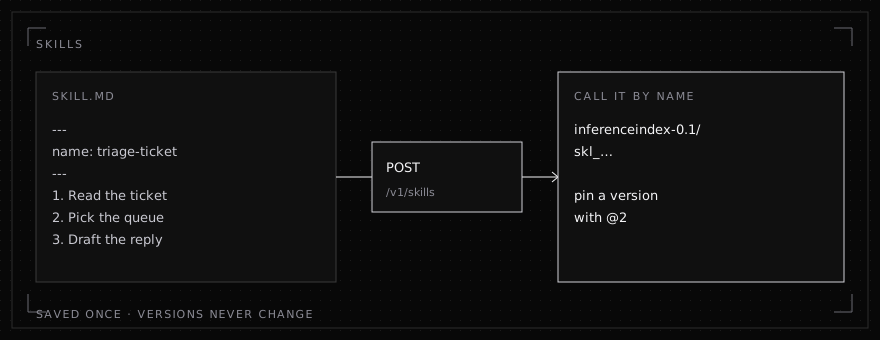
A skill is the job your agent does, written as a short Markdown procedure with numbered steps. Save it once and every run of that job can name it. A standard SKILL.md, the Agent Skills format Claude Code and Codex write, is taken as it is.
Bring a SKILL.md
Send the file's text as skill. Nothing needs converting.
- Name and description. The frontmatter
nameanddescriptionbecome the skill's name and description. The rest is the instructions. - Steps. The outermost numbered list is the steps. Numbered lines inside code fences and nested lists are not steps. Several numbered lists become one procedure, each step named by the heading above it. A file with no numbered list runs as one step.
- One file. Only the file itself is read, not the files it points to, such as
references/orscripts/. - Size. A skill can be up to 20,000 characters.
Save one
curl https://api.inferenceindex.com/v1/skills \
  -H "Authorization: Bearer YOUR_KEY" \
  -H "Content-Type: application/json" \
  -d '{"name": "triage-ticket", "skill": "1. Read the ticket.\n2. Pick the queue.\n3. Draft the reply."}'
name can be left out when the skill names itself, with a frontmatter name or a # Title. Saving checks the skill, and the response has its id, skl_….
| Call | What it does |
|---|---|
POST /v1/skills with { "name", "skill" } | Saves a new skill |
GET /v1/skills | Lists your skills |
GET /v1/skills/:id?version=2 | Reads one, at a version if you give one |
POST /v1/skills/:id/versions with { "skill" } | Adds a version. A saved version never changes. |
DELETE /v1/skills/:id | Archives it. It can't be called after that, and its versions are kept. |
A skill belongs to the account that saved it. Another account's skill answers 404, the same as one that doesn't exist.
Call it
Put the id in the model name: inferenceindex-0.1/skl_…, or inferenceindex-0.1/skl_…@2 to pin version 2. Without a version, the current one runs.
response = client.chat.completions.create(
    model="inferenceindex-0.1/skl_YOUR_SKILL_ID",
    messages=messages,
    tools=tools,
)
You can also name it in the body as skill_id and skill_version (extra_body in the OpenAI SDKs), or send the skill's text as skill. Agents that can only set headers can send X-Skill-Id and X-Skill-Version. Naming two different skills in one request is refused with skill_conflict.
Your system and developer messages become the run's instructions, and your user messages its request. Every saved skill is listed by GET /v1/models.
Hints, scripts, and checks
A skill can also carry prepared responses and scripts. Code mode is where those go: a ## Hints block for wording, and a ## Scripts block for writes the skill defines. Checks are the ## Checks block below. Images on a run are on the images page.
Checks
A ## Checks section is a fenced JSON block keyed by step number, starting at 1. Each step's value is a list of checks. Code runs them. A step has not succeeded while a required check is still failing. The response lists them on inferenceindex.checks, and the quickstart shows that object.
| Field | What it is |
|---|---|
id | A name for the check. If you leave it out, it is check_1, check_2, and so on. |
required | Default true. Set false and the step can still succeed while this check fails. |
onFailure | loop, reject, fail, or escalate. Default fail. |
read | A follow-up read: tool, optional args, and optional expect. |
schema | A JSON schema for the result. |
status | An HTTP status, or a list of them, from 100 to 599. |
verdict | true asks for this step's own verdict once its other checks have passed. |
A check needs a read, a schema, a status, or verdict set to true. When read is set, schema and status apply to that read's result. Otherwise they apply to the step's own result.
onFailure says what happens when a required check fails:
loop. The step is tried again, up to 2 further times. If it still fails, the run stops with outcomefail. If a write's outcome is uncertain, the write is not sent again and the outcome isescalate.reject. The run stops with outcomerework.fail. The run stops with outcomefail.escalate. The run stops with outcomeescalate.
read.args values are literals, or { "from": "args", "field": "id" } or { "from": "result", "field": "id" } to copy from the step's call. expect is the fields the read must show. A dotted name reads a nested field. A list passes when any record in it matches.
# Record a payment

Use when an invoice should be marked paid and the ledger should show that it was.

1. Read the invoice.
2. Mark the invoice paid.

## Checks

```json
{
  "2": [
    {
      "id": "landed",
      "required": true,
      "onFailure": "fail",
      "read": {
        "tool": "get_invoice",
        "args": { "id": { "from": "args", "field": "id" } },
        "expect": { "status": "paid" }
      }
    }
  ]
}
```
A step that only checks the call's own result can use status and schema instead of a read:
{
  "1": [
    { "id": "http", "required": true, "onFailure": "fail", "status": 200 },
    {
      "id": "shape",
      "required": true,
      "onFailure": "fail",
      "schema": {
        "type": "object",
        "required": ["id", "status"],
        "properties": {
          "id": { "type": "string" },
          "status": { "type": "number" }
        }
      }
    }
  ]
}
No skill yet
Send "plan": true in the body, with your tools and no skill named. A skill is written for the request from your tools, after reading what the request depends on, and the run follows it. Send "plan": {"save": true} to keep it as one of your skills, marked for review.
plan.read_first defaults to true: those reads happen first, as ordinary tool calls, and the skill is written from what they return. Set it to false to write the skill from the request alone. While those reads are still going out, inferenceindex.plan.status is reading.
plan.reasoning is how hard your fallback model reasons while it writes the skill. It defaults to high, whatever reasoning_effort says for the rest of the run. The efforts are none, minimal, low, medium, high, xhigh, and max. The rest of the run follows reasoning_effort, which defaults to none.
Once the plan exists, inferenceindex.plan carries its id (pln_…), name, status, and skill_id. status is pending, worked, or needs_work.
| Call | What it does |
|---|---|
GET /v1/plans?status=pending | Lists your plans. status is optional: pending, worked, or needs_work. |
GET /v1/plans/pln_… | Reads one plan. Another account's plan is not found, the same as one that does not exist. |
POST /v1/feedback with { "plan_id", "worked", "comment" } | Says whether the plan did the job. worked is true or false. comment is optional, up to 4,000 characters. |
GET /v1/plans returns { "plans": [ { "id", "name", "status", "skill_id", "createdAt", "updatedAt" } ] }.
GET /v1/plans/pln_… returns id, name, body, sha256, request, toolNames, status, skillId, createdAt, updatedAt, and feedback. Each feedback item is worked, comment, and createdAt.
POST /v1/feedback for a plan is plan_id with worked. Do not mix that with run_id and completed in the same body. The response is { "plan_id", "status" }. A body that mixes them, or sends neither pair, is 400 with invalid_body and the message Send run_id with completed, or plan_id with worked. The run's own completed feedback is on the quickstart.